East Africans are trading more with each other, benefiting from a stronger and more connected marketplace. Intra-EAC trade grew by 27%, rising from USD 14.2 billion to USD 18 billion between June 2024 and June 2025.
During the same period, the region’s total trade with the rest of the world rose by 22%, from USD 115.4 billion to USD 140.8 billion.
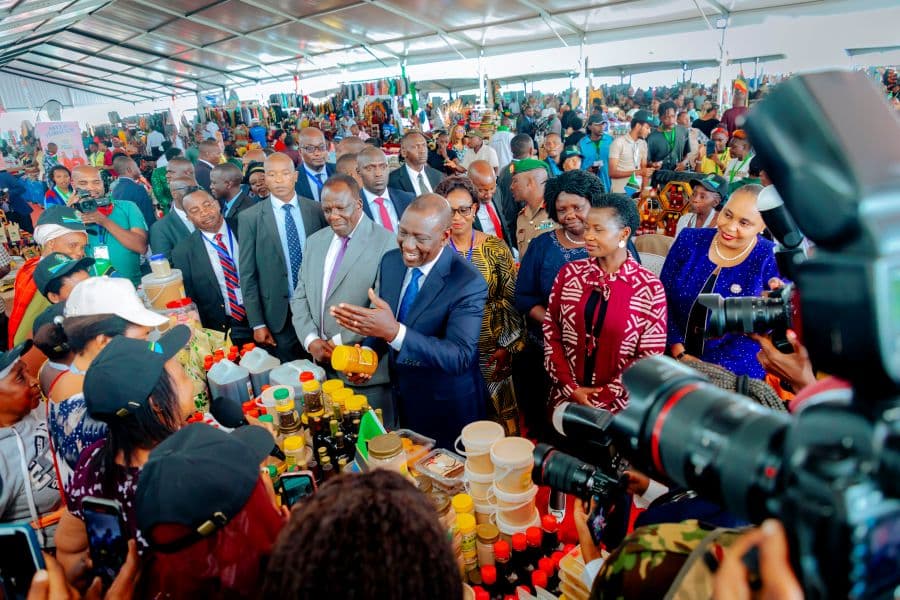
The figures were revealed at the opening of the 25th East African Community (EAC) Micro, Small and Medium Enterprises (MSMEs) Trade Fair in Nairobi, Kenya. The event brings together innovators, entrepreneurs, and business leaders from across the region to showcase products and deepen cross-border collaboration.
The fair was officially opened by Dr William Samoei Ruto, President of Kenya and Chair of the EAC Summit of Heads of State, at Uhuru Gardens in Nairobi.
President Ruto reaffirmed the EAC leaders’ commitment to removing non-tariff barriers that hinder regional trade. He said the rise in trade and investment signals a more mature internal market driven by innovation, competitiveness, and a shared goal of regional prosperity.
He added that the trade fair provides a key platform to address trade challenges ahead of the EAC Summit in early December 2025. “The conversations shaping this fair are ambitious and action-oriented, focusing on digital transformation, affordable finance, expanded markets, and green enterprise,” he said.
Held under the theme “25 Years of EAC Integration: Advancing Innovation and Regional Value Chains for Competitive MSMEs towards Sustainable Development,” the 2025 Trade Fair features over 3,000 exhibitors from all eight partner states.
Running from November 7 to November 16, 2025, the event is organised by the EAC Secretariat in partnership with the Confederation of Micro and Small Enterprises Organisation (CMSEO–EA) and partner states. It serves as a platform for showcasing products, expanding market access, and building regional business networks.
Through exhibitions, workshops, and business engagements, participants gain new skills, explore emerging technologies, and enhance competitiveness within and beyond the region.
Kenya’s Cabinet Secretary for Cooperatives and MSMEs Development, Hon. Wycliffe Oparanya, called for stronger access to finance to help MSMEs secure affordable and inclusive financial services. He urged the removal of trade barriers and support for cross-border linkages to open regional and continental markets.
“We must help MSMEs adopt technology, embrace e-commerce, and embed sustainability in their business models,” he said. “Joint programmes and harmonised policies that deepen integration will ensure MSMEs continue driving economic transformation.”
EAC Deputy Secretary General for Customs, Trade and Monetary Affairs, Annette Ssemuwemba Mutaawe, urged partner states to boost local production, strengthen regional value chains, and improve MSME access to finance, technology, and markets.
She noted that transforming exports from raw commodities to high-value manufactured goods is vital for sustainable growth. “Manufactured exports account for less than 30% of total exports, while 64% of imports are manufactured goods, mainly from Asia. Strengthening regional value chains can reverse this trend and build our own capacity,” she said.
The EAC continues to support MSMEs through several initiatives. These include reviewing Rules of Origin to support industrial growth, enhancing regional connectivity through smart infrastructure, operationalising the EAC Payment and Settlement System for local currency transactions, and expanding training opportunities for women and youth in cross-border trade.
The event also honoured 16 EAC Women in Trade Champions for their leadership in advancing intra-EAC trade and 18 winners of the Regional Quality Awards for innovation and product excellence.
The EAC Women in Trade Champions Initiative is a partnership between the EAC Secretariat, the East African Business Council (EABC), and the East African Women in Business Platform (EAWiBP), supported by GIZ–LIFTED, a project co-financed by the European Union (EU) to promote women’s participation in regional integration.