
By Dennis Katungi
The other week I glanced at my immediate neighbour’s Newspaper – as we sat next to each other at the Commonwealth Trade & Investment Summit in London. The lead story on page 2 of The Times, a respected British Broadsheet run: ‘Gorilla adventure film saved from Rwanda by a whisker. - Attenborough reveals how the famous gorilla trek footage nearly got confiscated by Habyarimana’s men in Kigali’.
This got me curious. I tend to think of Habyarimana’s armed men as the infamous (Interahamwe) who carried out genocide in Rwanda, and indeed it was. At Tea Break, I sneaked out of the Conference Building and got a copy of The Times. In it, I read the story - how Sir David Attenborough and his cameraman Martin Saunders were held at gunpoint in Rwanda, accused of filming without permission way back in 1978.
Sir David Frederic Attenborough is a British broadcaster, natural historian, biologist, and writer whose eight-decade career has revolutionised nature documentaries. He is the man behind The BBC flagship epics (Planet Earth, and The Blue Planet). A former BBC Executive and tireless environmental advocate, he has earned every major global TV award and become one of the trusted voices on the natural world. In a week, on 08th May, he turns One hundred years old and still works.
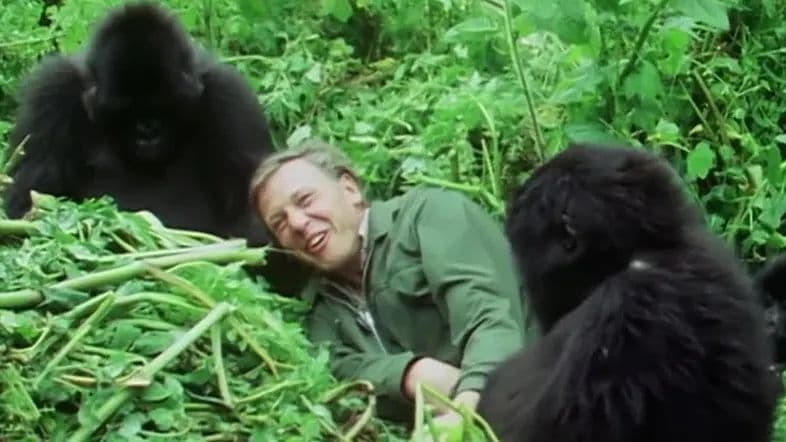
His close encounter with the Gorillas of Bwindi and Virunga mountains in 1978 became one of the top TV documentaries of all time. However, a new epic (Life on Earth) has revealed how the footage that cemented its Land mark status as a BBC’s top documentary nearly almost never made it out of Rwanda in 1978. Sir Attenborough filmed Gorillas in the Virunga stretch – along the Albertine Rift Valley which extends from Virunga Mountains to the Rwenzori Ranges.
First, I digress. What got me hooked onto travel and Tourism? I was born, raised and educated in Uganda before I went to University in England. However, I knew very little about my country Uganda, the Pearl of Africa. Like many young people growing up in the rural Uganda of the 70’s and 80’s, travel and tourism was not on the horizon. I completed my Primary school without a single school trip to talk about. In fact, the major tourism sites I had visited before travelling to the United Kingdom – were the Rippon Falls (source of the Nile in Jinja). That was because I went to High School in Jinja. The other teenage interesting experience I remember was my Train journeys back to High School. We would board the Train at Kabogore and alight at Kampala Central Railway Station before connecting to Jinja by Taxi.
When I took my first job in London, I was amazed by the stories of workmates who knew Uganda more than I did. They had been to our National Parks, sailed on the Nile, trekked gorillas in Bwindi, watched birds in the popular Mabamba Swamp, done water rafting on our lakes, visited our historical and cultural sites. I felt challenged.
How could these foreigners know the beauty of my country and I, a proud patriotic Ugandan knew close to nil? This is what triggered me to embark on a Tour of almost all of our National Parks and other national assets when I returned. The thought was nibbling at me; how could I claim my proper citizenship as a Ugandan when I knew nothing about Uganda apart from what I picked in Geography lessons at School. Why is Uganda called ‘The Pearl of Africa’?
As they say; seeing is believing. It is important for Ugandans to know and appreciate their country. It ought to be part of the Lessons we take in School. Government should consider sponsoring all schools in Uganda for Tours that explore the national assets. Did you know that Ugandans pay the lowest rates for Park entrance fees and activities? The government subsidises for citizens to make it more affordable to enjoy their Country’s rich wildlife and natural beauty. Go for it.
Lord Attenborough tells his hair-raising stories in the new series which will air on BBC to celebrate his 100’s birthday. In one, he says: “After months of planning, we travelled to Uganda and on to Rwanda for our shoot the Virunga National Park. We had no idea how close we would come to loosing everything” The first sign of trouble was a soldier trying to flag us down on our way to Kigali. My driver ignored him and we drove on. He loaded his rifle and shot in the air. The loud bangs felt like we were in some feature film with bullets going by. A Landcruiser zooms past us, blocks the middle of the road, so we must stop. The armed man in the Land rover is enraged that we had been filming, we had no permit. We did not check with the National Park office”
Suspected of filming sensitive material, the crew was transported to Police Headquarters in Kigali to be interrogated. Meantime, in the back of their vehicle, Martin Sanders the Cameraman set about swapping the labels on the film containers to make it look like those containing the gorilla footage were unused. The crew were also taken to Military Intelligence and made to stand and wait in the simmering sunshine - prompting Martin Sanders to ask: “are they going to put us up against the wall and shoot us”? Eventually, they were released. Lord Attenborough muses “the tension only eased when the Plane was airborne”. But why film without permission in the first place, I ask?
The famous British broadcaster is known for describing his close encounter with Gorillas, where he is seen lying next to a mother gorilla with its babies: “It was one of the most privileged moments of my life”. Lord Attenborough’s work propelled him to become one of the foremost British natural history presenters of all time which resulted in bosses wanting him to become the BBC’s director-general. He turned it down. “I wouldn’t have been any good as the director-general. It’s a hugely demanding job and the skills are not mine. I don’t have political skills and sensitivities. I know about birds and gorillas of the paradise, but I certainly don’t know about prime ministers.” Happy 100th birthday Lord David Attenborough. You’ve made your mark on Planet Earth.
The writer, Dennis Katungi is Head of Communications & Media Relations at Uganda Media Centre.
@Dennis_Katungi