

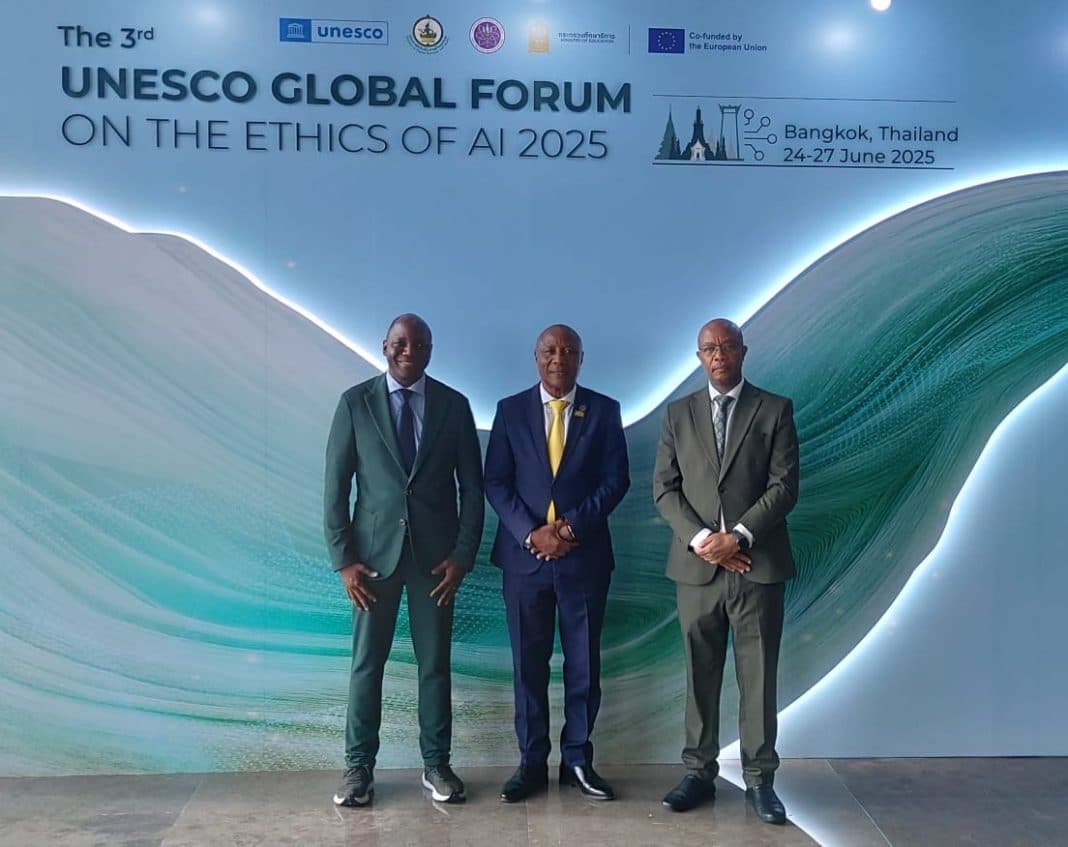
Uganda has reaffirmed its commitment to ethical and inclusive artificial intelligence (AI) governance during the 3rd UNESCO Global Forum on the Ethics of Artificial Intelligence, held in Bangkok, Thailand.
Representing the country at the international gathering, Godfrey Baluku Kabbyanga, Minister of State for ICT and National Guidance, delivered a keynote address in the Ministerial Session, positioning Uganda as a leader in advancing responsible AI development in Africa.
“For Uganda, AI must function as a bridge—not a wall—to opportunity, dignity, and shared growth,” Hon. Kabbyanga stated, emphasizing the country's approach to digital innovation rooted in human rights and inclusivity.
A major highlight of the forum was UNESCO’s selection of Uganda for the next phase of the AI Readiness Assessment Methodology (RAM). The evaluation will be conducted by national experts, with technical support from UNESCO, building on the foundation laid by the 2024 “Uganda AI Landscape” study, completed in collaboration with the International Telecommunication Union (ITU).
Uganda was also named as a beneficiary of the Supervising AI by Competent Authorities training initiative—a joint effort by UNESCO, the European Union, and the Dutch Authority for Digital Infrastructure. The program is designed to enhance public officials’ capacity to regulate AI in line with global ethical standards.
The country’s growing strides in AI readiness stem from efforts spearheaded by the Ministry’s Department of Research and Development. These include identifying national AI use cases, assessing policy gaps, and engaging stakeholders like the United Nations Development Programme (UNDP) to shape Uganda’s future in emerging technologies.
These efforts are contributing to the drafting of Uganda’s National Strategy for AI and Emerging Technologies Governance, developed with World Bank support through the Uganda Digital Acceleration Project (UDAP). The strategy aligns with the Digital Uganda Vision and the African Union’s continental AI framework.
Uganda’s delegation to the forum also featured Ambrose Ruyooka, Head of Research and Development at the Ministry of ICT and National Guidance, who noted, “We are not starting from zero. Uganda has already taken purposeful steps—from readiness reviews to institutional capacity-building—towards ethical AI governance.”
In a high-level panel session on implementing UNESCO’s AI ethics recommendations, Kabbyanga announced Uganda’s plan to establish a National AI Task Force. The task force will coordinate AI policy development and implementation across sectors.
UNESCO officials welcomed Uganda’s continued leadership. Dr. Lidia Arthur Brito, UNESCO’s Assistant Director-General for Social and Human Sciences, commended the progress. “Through this partnership, UNESCO is committed to assisting Uganda in building governance systems that uphold ethical values, foster transparency, and ensure that AI contributes positively to sustainable development and human rights protection,” she said.
The forum, which also featured remarks by Thailand’s Prime Minister H.E. Paetongtarn Shinawatra and UNESCO Director-General H.E. Audrey Azoulay, underscored the global urgency of aligning AI with human rights and inclusive growth.
The Ministry of ICT and National Guidance expressed gratitude to UNESCO and all development partners supporting Uganda’s digital transformation journey. As AI adoption grows globally, Uganda aims to lead by example in ensuring AI technologies serve all citizens ethically and equitably.