

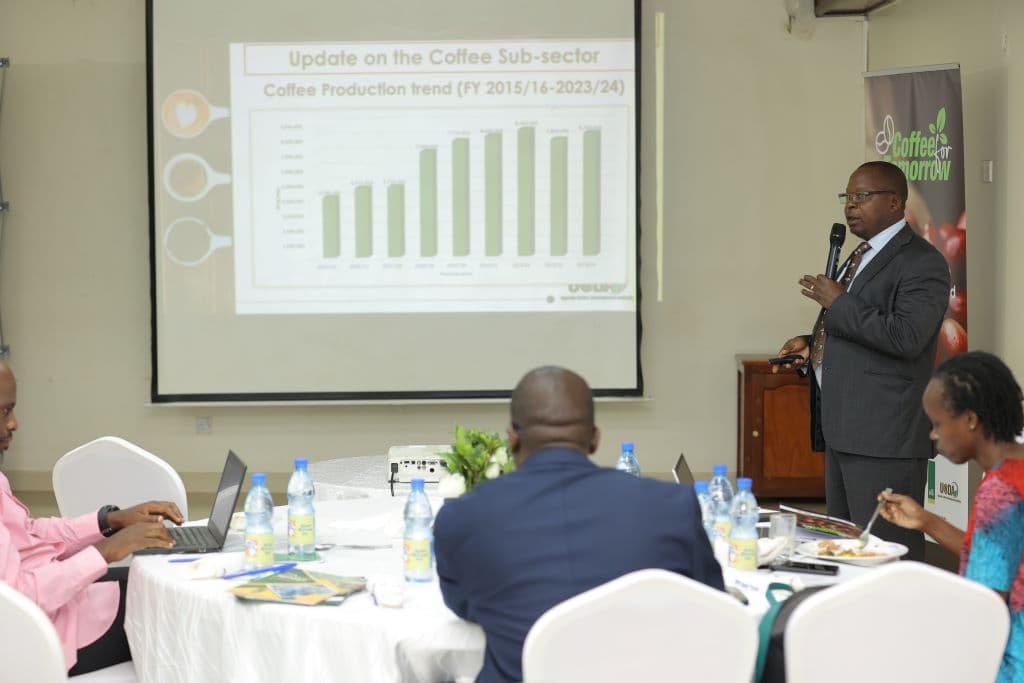
The Uganda Coffee Development Authority (UCDA) and the National Task Force have ramped up efforts to ensure Uganda’s coffee industry meets the European Union's Deforestation Regulation (EUDR) requirements. In a meeting held at Hotel Africana on September 3, stakeholders, including media representatives, were briefed on Uganda's preparedness for compliance with the new EU standards.
Robert Nangatsa, an Extension Manager at UCDA, highlighted the importance of the EU market for Uganda, noting it accounts for about 60% of the country’s coffee exports. “It is imperative that we comply with the EUDR to maintain access to this market,” Nangatsa emphasized. He outlined that the EUDR mandates detailed land-use maps and due diligence statements from exporters to verify deforestation-free coffee production.
To facilitate compliance, UCDA has already implemented a Geospatial Monitoring and Evaluation System and a Farmer Registration App, aimed at registering coffee farmers and other value chain actors. These tools are designed to ensure traceability and align with the Uganda National Coffee Act 2021, which prioritizes sustainable and traceable coffee production.
A dedicated unit has been established within UCDA to oversee the EUDR implementation process, working closely with the private sector, ministries, departments, agencies, and other stakeholders. UCDA is also organizing national workshops to educate stakeholders on EUDR compliance, stressing that awareness and capacity building are crucial for successful implementation.
Dr. Gerald Kyalo, UCDA’s Director of Development Services, underscored the critical role of farmer registration in ensuring traceability and access to the EU market. He explained that registration involves capturing farm geo-locations and farmer details, with larger farms requiring more detailed polygon mapping. “The regulation requires that we show evidence that our coffee doesn't contribute to deforestation,” said Dr. Kyalo, highlighting the importance of maintaining a comprehensive register of coffee farms.
Samson Emong from the National EUDR Task Force reinforced the urgency of accurate reporting and compliance with EU deforestation and sustainability standards. The Task Force presented a strategic plan to enhance supply chain transparency, promote sustainable agricultural practices, and support smallholder farmers in aligning with EUDR requirements.
With the EU market being a significant destination for Uganda’s coffee exports, compliance with the EUDR is crucial to safeguarding the country’s market access. The ongoing efforts by UCDA and the National Task Force are aimed at ensuring the sustainability and traceability of Uganda’s coffee, securing its place in the competitive global market.