

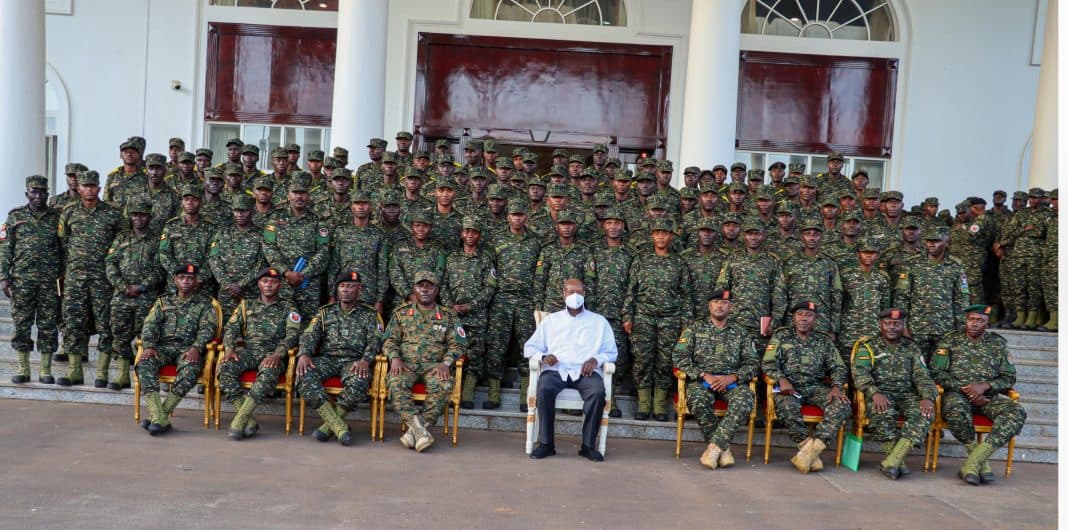
President Yoweri Kaguta Museveni has urged Uganda People’s Defence Forces (UPDF) officers to reject identity-based politics and embrace economic transformation and regional integration as pillars of national prosperity and strategic security.
While addressing officers and trainees from the Armoured Warfare Training School during a lecture at State House Entebbe on June 10, the President warned that identity politics undermines unity and development. He challenged the officers to safeguard Uganda against such divisions.
“Africa has gone through slave trade, colonialism, and neo-colonialism in the last 500 years because of weak governance. That’s how Europeans took over,” said President Museveni, who also serves as Commander-in-Chief of the UPDF.
He emphasized that national prosperity must come from producing and selling goods and services with “ekibaro” (calculation). He discouraged reliance on foreign aid, calling it an unsustainable path to development.
“You can’t get prosperous from aid. If that were the case, Africa and Latin America would be rich. Prosperity comes from production and trade,” he said.
Museveni cited examples of surplus production in Uganda, such as sugar and milk, stressing the need to access larger regional and continental markets to avoid oversaturation.
“Uganda produces 700,000 metric tons of sugar but only consumes 300,000. Similarly, we produce 5.4 billion litres of milk and consume only 800 million. We must look beyond our borders,” he said.
The President highlighted the importance of rejecting tribalism, urging officers to view tribes as contributors to unity rather than as dividing lines.
“Tribes are important but should not limit our national vision. No tribe can prosper alone,” he added.
He also called for a shift from manual labour to skilled and mechanized work, describing sustainable development as a transformative journey, not a static state.
“All families in Uganda must move from using muscle to using skilled and machine labour,” he said. “You can’t have sustainable development without transformation—just like you can’t have a sustainable pregnancy.”
Museveni warned that producing similar goods without expanding markets would reduce their value. He used the example of simsim in Orom, where oversupply without external demand leads to limited income for producers.
He further called for renewed efforts toward regional integration. Reflecting on the failed East African Federation attempt in 1963, Museveni said leaders like Obote and Kenyatta missed a vital opportunity due to external influence, while Tanzania succeeded because of visionary leaders like Nyerere and Karume.
“It’s unfortunate some leaders chose to be big fish in small ponds. That missed opportunity led to later problems like Idi Amin,” he said. “We must pursue political and economic integration with our neighbours for lasting peace and shared prosperity.”
The President called for unity among East African communities—Bantu, Nilotics, and Nilo-Hamites—under the principle of undugu (brotherhood), saying shared history and culture can serve as a foundation for integration.
“Why not leverage these shared characteristics to unite our people?” he asked.
Brig. Gen. Peter Chandia, Commandant of the Armoured Warfare Training School, thanked the President for the lecture, calling it a valuable addition to their curriculum and a source of inspiration.
“This lesson today has brought out significant points important for our courses and has inspired us to continue working hard to defend Uganda and Africa,” said Brig. Gen. Chandia.
The school is currently training officers in combat engineering, tank operations, and armour platoon command. The graduation ceremony for the current cohorts is scheduled for July 2025.
Senior officers in attendance included Chief Instructors Lt. Col. Nathan Atwine and Maj. James Sikusoka.