
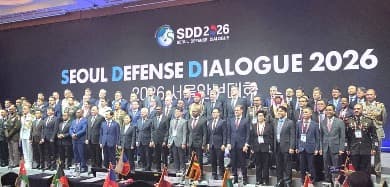
Defence and Veteran Affairs minister Kiryowa Kiwanuka has urged countries to abandon rigid alliances based on identity and build flexible partnerships centred on capabilities and shared interests.
Kiwanuka made the call during a plenary session at the 15th Seoul Defence Dialogue in Seoul, South Korea.
The meeting ran from September 7 to 9, 2026, under the theme “Toward the New Coexistence in the Age of Turbulence.”
It attracted ministerial officials from more than 70 countries. They discussed global security challenges, including tensions on the Korean Peninsula and emerging threats in cyber and space.
“Our central proposition is this: the evolution of alliances is a transition from a rigid, identity-based geopolitical alignment towards flexible, interest-based and capability-oriented partnerships founded on sovereignty, mutual respect, reciprocity and shared responsibilities,” he said.
Kiwanuka traced the development of international alliances through six stages. These ranged from dynastic and temporary arrangements before 1648 to the balance of power and Cold War blocs.
He also discussed cooperative security, counter-terrorism networks and the current period of strategic competition and multi-domain security.
Kiwanuka said modern defence cooperation should focus on what each partner can contribute to addressing a specific security threat.
He argued that the key question was no longer, “Who is my ally against whom?” but “Who can contribute useful capabilities to particular security challenges?”
The minister also outlined the evolution of Uganda’s defence partnerships since independence. He said changing security needs and national priorities had shaped the country’s choices.
He cited Uganda’s role in regional and international peace operations, particularly in Somalia, as evidence of its growing contribution to African security.
Kiwanuka said Uganda bases its approach on patriotism and Pan-Africanism. He added that strategic autonomy should help the country strengthen its capacity without cutting itself off from other nations.
“Strategic autonomy should not be understood as strategic isolation,” Hon. Kiryowa said.
He said Uganda follows the principle of “interests, not identity” when selecting defence partners. It does not base such relationships on race, religion or geography, he added.
“A perfect example is Uganda and the Republic of Korea. Geographically and culturally distant, yet we are partners in professional military education, Taekwondo, military healthcare and defence modernisation. We do not need to be identical to be partners,” he said.
Kiwanuka proposed five changes to guide future defence cooperation. He called for a shift from security assistance to sustainable capability and urged the world to treat Africa as a security partner instead of a recipient.
He also supported greater African responsibility backed by international partnerships, defence industrialisation, technological sovereignty and investment in human capital.
“Technology without adequate human capacity can create dependency rather than capability,” he warned.
Kiwanuka also held talks with South Korean National Defence minister Ahn Gyuback on the sidelines of the dialogue. They explored ways to deepen defence ties and expand cooperation.
Kiwanuka proposed a Centre of Excellence for Taekwondo in Uganda with technical support from South Korea.
He said the centre would train military personnel and civilians, develop instructors and coaches and promote technical exchanges. It would also serve as a lasting symbol of the relationship between Uganda and South Korea.
The minister also sought Korean support for Uganda’s military medical sector. Uganda is developing military health infrastructure, including a referral hospital.
The proposed cooperation would cover training, hospital management, medical technology, specialist education and exchanges between military hospitals.
The ministers agreed that sustainable security requires defence capabilities, deterrence, modernisation, dialogue, international cooperation and capacity building.