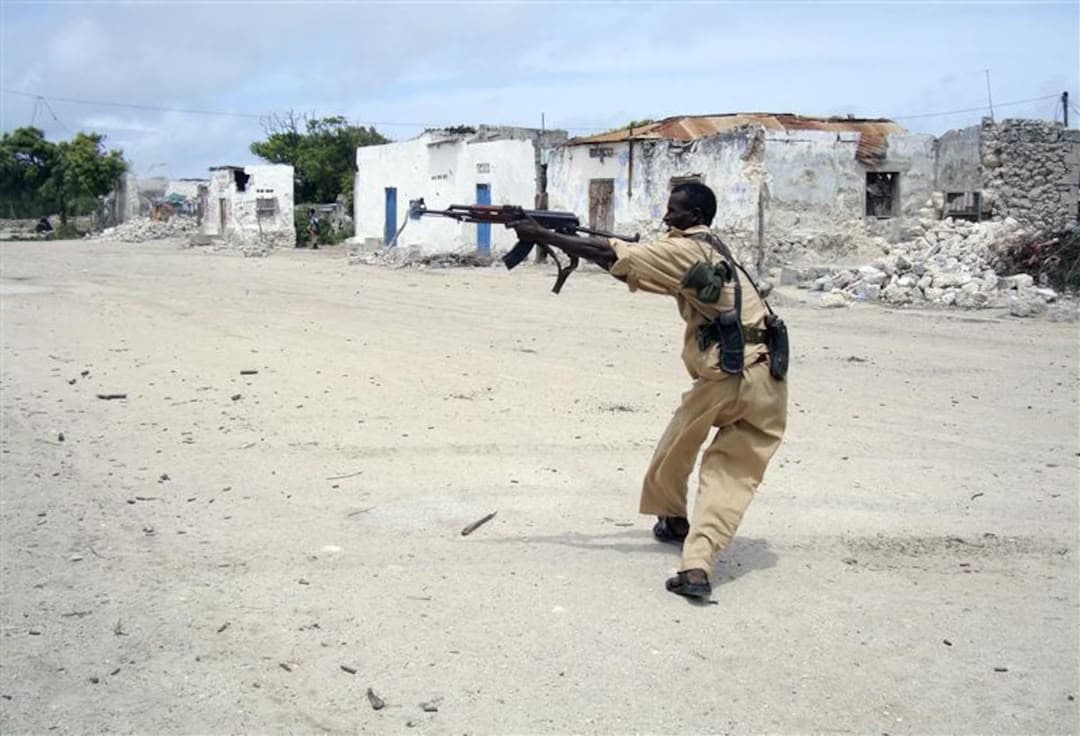
Fierce gunfire and heavy artillery exchanges have shaken the Somali capital as political instability boils over into a full-scale armed confrontation.
The violence erupted late Wednesday and intensified into Thursday morning, with state security forces engaging in pitched battles against forces loyal to top opposition figures – namely former Prime Minister Hassan Ali Khaire and former President Sharif Sheikh Ahmed.
The sudden outbreak of violence followed weeks of mounting political tension after President Hassan Sheikh Mohamud unilaterally pushed through constitutional amendments extending his executive mandate for an additional year. His official term expired on May 15.
The epicenter of the fighting centered on the Abdiaziz and Howlwadaag residential districts.
Pro-government forces reportedly raided the properties of former Prime Minister Hassan Ali Khaire and former President Sharif Sheikh Ahmed.
Both leaders recently left the safety of the airport's fortified green zone to spearhead massive anti-government street protests scheduled for Thursday.
In a series of public statements, Khaire said that state forces subjected his compound to a sustained, 20-hour assault while he was meeting with local clan elders. He accused President Mohamud of using advanced weaponry, including drones, in densely populated urban neighborhoods.
"An attack was launched against us by forces commanded by the president whose term has expired," Khaire posted on social media, condemning the deployment of counter-terrorism resources against civilian leaders.
Beyond the immediate gun battles, the roots of this crisis run deeper. The breakdown in Mogadishu occurs against a backdrop of prolonged friction between the federal government and regional states, fueled by intense public and political scrutiny over President Mohamud's extensive Turkish backing.
Under bilateral defense and economic agreements, Turkey has provided military training to elite units like the Gorgor special forces, supplied combat drones, and secured expansive energy partnerships.
Opposition factions and regional administrations—particularly in the Southwest State's interim capital of Baidoa—allege that federal authorities are using Turkish-supplied hardware and elite-trained troops to target domestic political adversaries and forcefully engineer local election results to centralize absolute control.
The sudden outbreak of internal factional warfare has sparked swift international condemnation, with foreign allies warning it threatens to reverse years of hard-fought security gains against al-Shabab extremists.
The United States Embassy in Mogadishu issued a sharp warning, calling the deployment of weapons in urban zones reckless. The statement emphasized that actions taken by leaders on both sides in the coming days will have "lasting consequences for Somalia's security, unity, and future."
However, with the opposition refusing to recognize the president's extended mandate and the government maintaining arrest warrants for top dissidents, the country faces its deepest constitutional crisis in decades.
 Africa