The government has recorded a modest improvement in gender and equity compliance in the national budget for the financial year 2026/27, according to a new report presented to the Ministry of Finance, Planning and Economic Development.
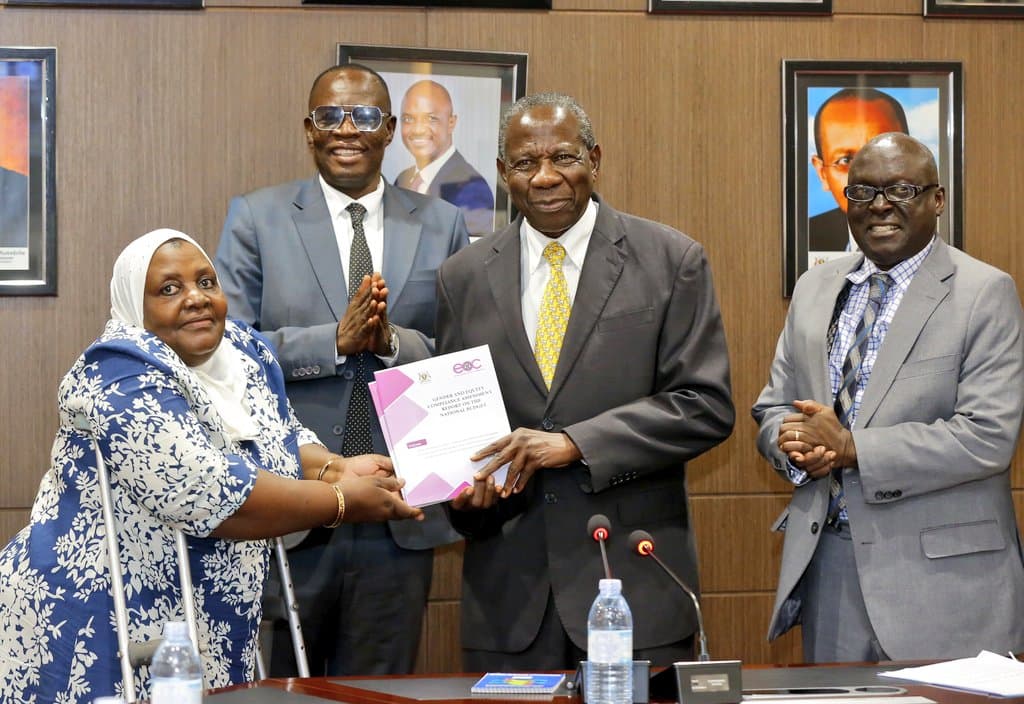
The report was handed to Finance Minister Matia Kasaija by Safia Nalule Juuko, Chairperson of the Equal Opportunities Commission (EOC), during a meeting held on Wednesday.
Speaking after receiving the report, Kasaija said the assessment plays a key role in strengthening accountability in public spending. He noted that the process is anchored in the Public Finance Management Act, Cap 171.
“The work undertaken by the Commission in assessing the gender and equity responsiveness of the national budget is an important accountability mechanism,” Kasaija said.
He added that the government remains committed to fairness in resource allocation. “Government remains firmly committed to ensuring that public resources are allocated in a manner that promotes inclusive growth and addresses structural inequalities,” he said.
According to Juuko, the overall compliance level stands at 70 per cent, up from 68 per cent in the previous assessment. She said the national budget alone scored 67 per cent, while ministerial policy statements averaged 70 per cent.
Despite the improvement, Juuko pointed out several gaps that continue to affect full compliance. She said some ministries, departments and agencies have failed to address regional disparities in their plans and budgets.
She also noted weak adherence to reservation schemes, which are meant to ensure that marginalised groups benefit from government programmes.
The findings suggest that while progress has been made, more effort is needed to fully align public spending with gender and equity requirements.