

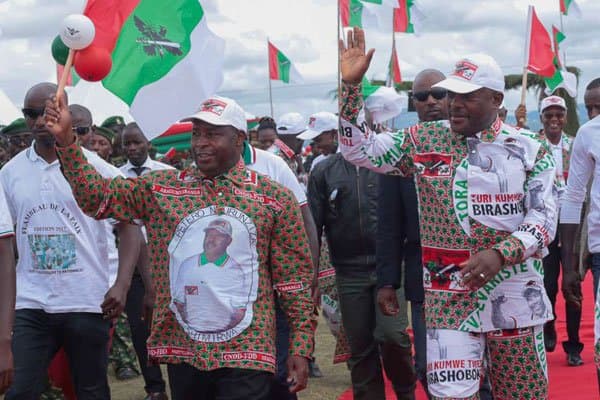
The Burundi Constitutional Court has ruled that the country does not need an interim president as stipulated by Article 121, saying the country already has a president-elect who should be sworn-in urgently.
The Court president Charles Ndagijimana said that since the president-elect is competent and the position of president is vacant, Evariste Ndayishimiye should be sworn in as soon as possible so that he can assume office in line with the country’s constitution.
This will come as a sigh of relief for many Burundians and Burundi watchers who were hoping and expecting for a smooth transition.
Burundi’s 2018 Constitution, Article 121, states that; “In case of vacancy caused by resigning, death or any other cause by the president then the Speaker of the National Assembly takes over in the interim until a new president is elected.”
But Burundi already has a president-elect.
Mr Ndayishimiye who is the current Secretary General of the ruling party CNDD-FDD was praised by the deceased president Nkurunziza on his ability to work for the people and unite.
During his maiden speech in Gitaga (Bugendana) during the official launch of political campaigns Gen Ndayishimiye vowed to fight ethnic divisions that have been the cause of decades of civil war.
“We want to see a Burundi whereby we don’t call each other a Hutu, a Tutsi or a Twa but calling ourselves Burundians,” said Gen Ndayishimiye on April 27, 2020.
The cyclic ethnic divisions in Burundi have led to the deaths of thousands of people.
Mr Evariste played a great role in the country’s political stability in facilitating the smooth signing of the Arusha Agreement and the cease fire agreement that brought an end to the country’s bloody civil war in 2005.
As flags are flying at half-mast in respect for the departed Nkurunziza, its business as usual in Bujumbura, although there is anticipation in the air. Currently there is no curfew in Bujumbura but residents return back home earlier than usual for fear of the unknown which is not strange here, despite the calm.
This is not the first time that the country has lost a sitting president, and this would have been the first time a sitting president peacefully and democratically hands over power at the end of his term.
Michel Micombero the country’s first president was ousted in a coup d’état in 1976 by an army officer Jean-Baptiste Bagaza, Bagaza ruled the country from 1976 to September 1987.
In 1987 Micombero’s regime was ousted by Maj. Pierre Buyoya. Buyoya’s regime ruled the country until 1993 when elections were conducted after mediation to stop the ethnic violence.
In 1993, democratic elections were conducted for the first time ever and the first democratically elected president Melchior Ndadaye won, but was assassinated in October 1993, barely three months in office.
It was the assassination of President Ndadaye that sparked ethnic violence that turned into a decade long civil war that killed more than 100,000 people.
After Ndadaye’s assassination, Cyprien Ntaryamira was selected to take over the office on February 1994 as a compromise.
His tenure was cut short after a plane carrying him and Rwanda’s president Juvenal Habyarimana was shot down on April 6, 1994 with just two months in the office.
CHANGE OF GUARD
On April 8 two days after the death of Ntaryamira, Sylvestre Ntibantunganya who was the speaker of the national assembly took over the office.
Mr. Ntibantunganya was over thrown by Pierre Buyoya in a military coup d’état in 1996 after two years in the office.
Pierre Buyoya’s second coup d’état succeeded and ruled the country from 1996 to 2003. Buyoya under sanctions due to the way he got back to the office and Arusha agreement he decided to hand over the office to a transitional government that was led by Domitien Ndayizeye from 2003-2005. Then President Pierre Nkurunziza took over the office from 2005-2020.
With all the history the civil war the country has went through, Burundi political crisis has shifted from ethnicity to political parties. The spectre of ethnic violence is less now, but in its place is political violence. And now anxiety as to what will come after Nkurunziza’s era.
-AFP