
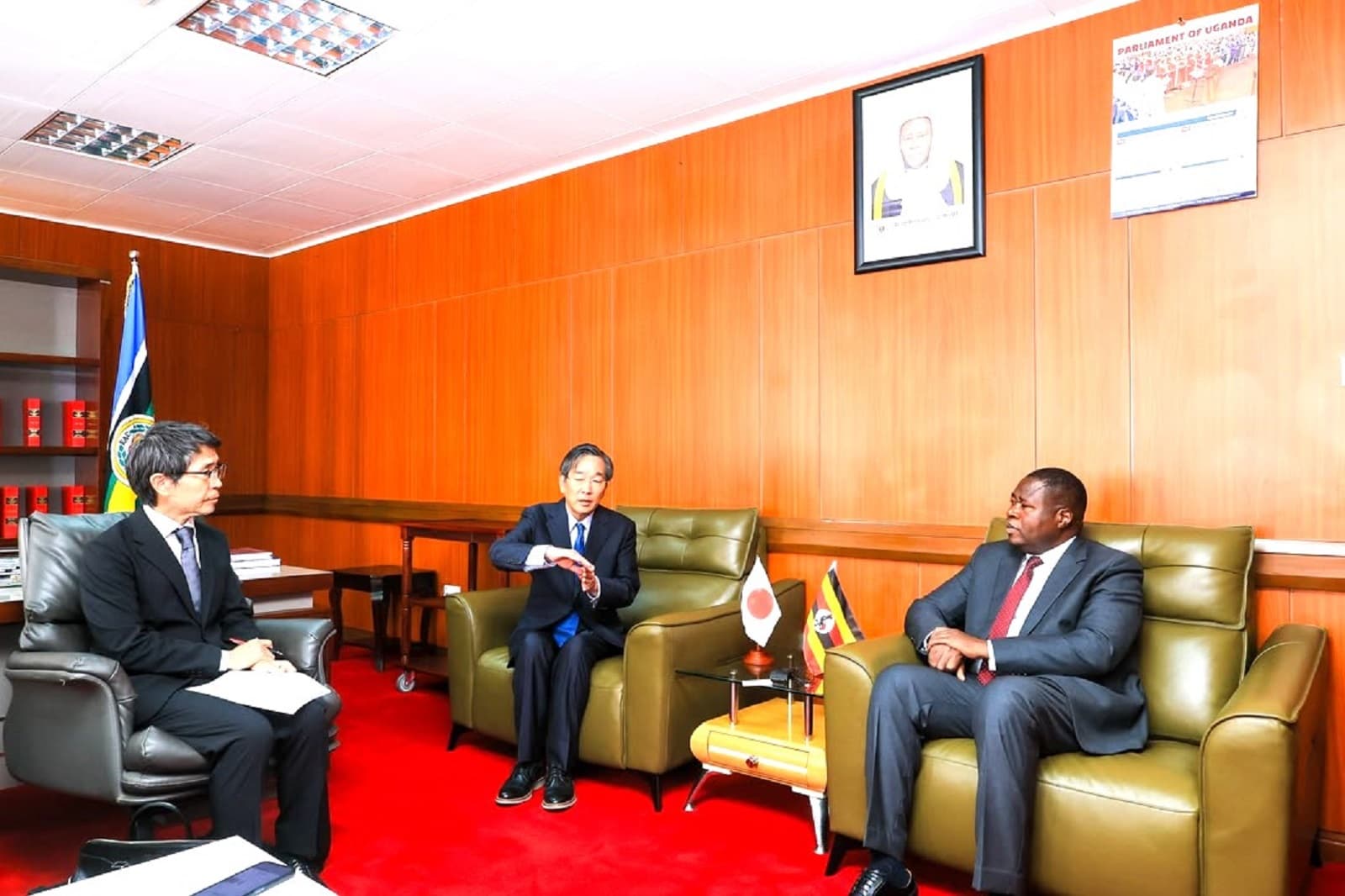
The Speaker of Parliament, Rt. Hon. Jacob Marksons Oboth, has pledged full legislative support for major Japanese-funded infrastructure initiatives in Uganda, including the construction of a new Karuma Bridge and the second phase of the Kampala Flyover.
Speaker Oboth made the commitment on Tuesday, November 24, 2026, during a bilateral meeting at Parliament with Japan’s Ambassador Extraordinary and Plenipotentiary to Uganda, H.E. Takuya Sasayama, who was accompanied by Deputy Chief of Mission Norimasa Yoshida and First Secretary and Head of Economic Cooperation Masanobu Yonemitsu.
During the discussions, Ambassador Sasayama revealed that construction of the new Karuma Bridge, a vital transport artery linking central and northern Uganda, is scheduled to commence on January 14, 2027. He petitioned Parliament to expedite approval of the project’s financing frameworks, including the Ugandan government’s counterpart funding expected to be tabled shortly by the Minister of Finance.
“We shall gladly do that,” Speaker Oboth assured the envoy, confirming that the financing request will be laid before the House immediately upon receipt.
Ambassador Sasayama further disclosed that Tokyo is preparing the second phase of the Kampala Flyover project, building upon the completed first phase and its upgraded traffic signal network, alongside expansions to the power transmission network across the Greater Kampala metropolitan area.
Praising Japan’s longstanding development partnership with Uganda, Speaker Oboth emphasized that Tokyo’s assistance has consistently been delivered transparently and without political conditions. He proposed establishing structured, multi-party parliamentary bilateral relations between Kampala and Tokyo, extending a formal invitation to his Japanese counterpart to visit Uganda—to complement traditional diplomacy and unlock opportunities in trade, tourism, cultural exchange, and innovation.
Ambassador Sasayama lauded Parliament’s pivotal role in Uganda’s democratic and socio-economic development, noting that Japan’s economic transformation relied on human capital and technology rather than natural resource wealth.
“We do not have any oil. Our aim is to co-create together with Japanese human resources and technology, and you have an abundance of young workforce. This is not only good for Uganda, but East Africa and the entire region as well,” Sasayama said.
Highlighting that 2027 will mark 65 years of diplomatic relations between Uganda and Japan, the ambassador also extended an official invitation for Uganda to participate in the International Horticultural Expo (Green Expo) in Yokohama, set to open in March 2027. Formal parliamentary ties between the two nations date back to 2013, when former Speaker Rt. Hon. Rebecca Kadaga undertook a working visit to Japan.