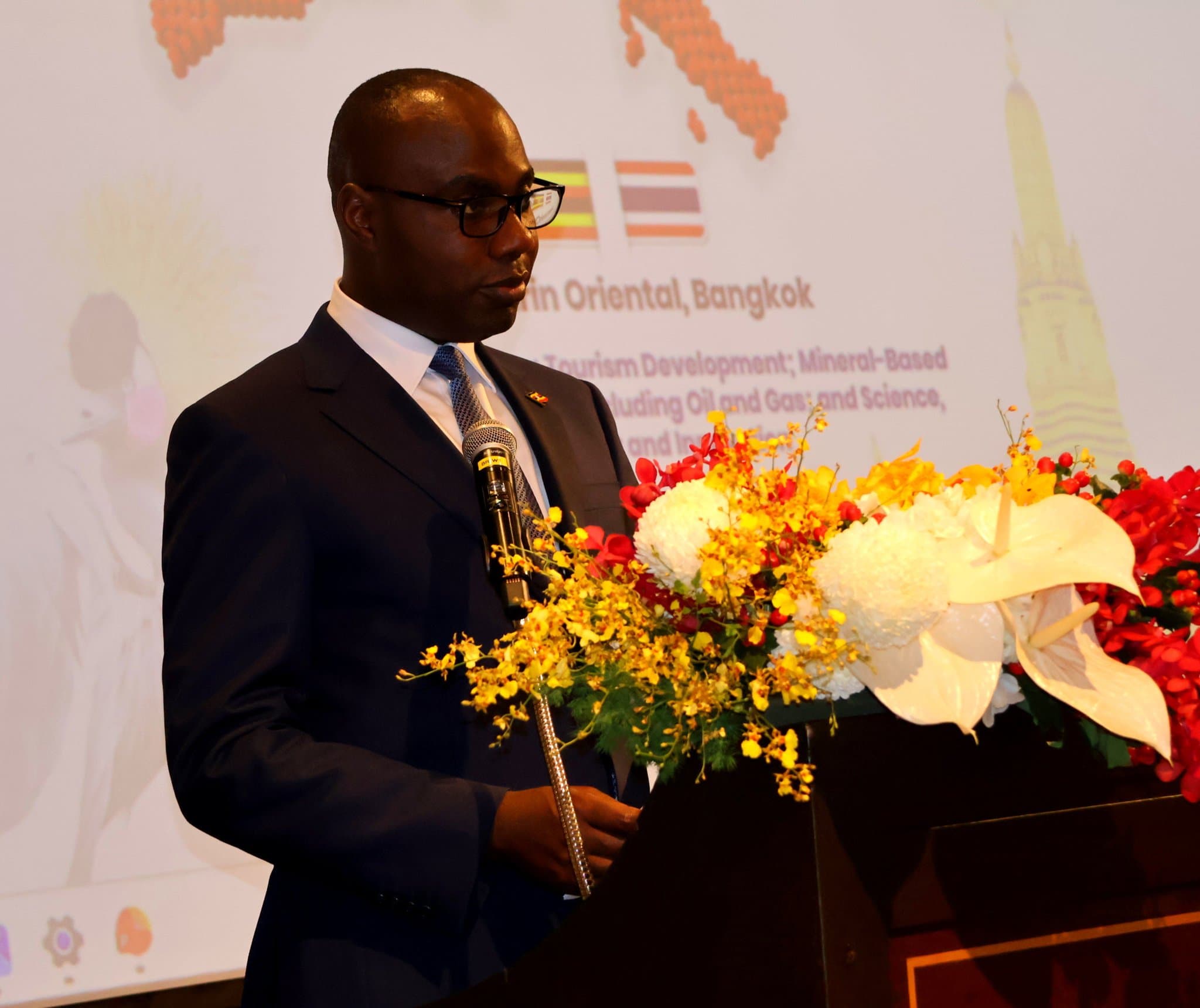
Uganda has pitched its crops and mineral deposits to Thai investors, seeking factories that can process raw materials, create jobs and boost exports.
Finance minister Henry Musasizi made the appeal at the Uganda-Thailand Economic Networking Dinner at the Mandarin Oriental Hotel in Bangkok on October 12, 2026.
He said Uganda wants to draw on Thailand’s experience in food processing, tourism and advanced manufacturing as it pursues a $500 billion economy by 2040.
“Together, let us turn the friendship between our two countries into factories, export growth, jobs and shared prosperity,” Musasizi said.
The minister outlined opportunities in coffee processing, meat and dairy production, pharmaceuticals, steel, fertilisers and cement. He also invited investment in tourism, hospitality and technology.
Musasizi said Uganda’s mineral deposits could support industries producing electric batteries, automotive steel, construction materials and electrical components.
He identified lithium as a resource for battery production, iron ore for steel, and copper and cobalt for electrical conductors and battery components. Phosphate deposits offer opportunities for fertiliser production.
He told investors that Uganda offers access to regional markets through the East African Community and the wider continent through the African Continental Free Trade Area.
The government, he said, is expanding industrial parks and export free zones while offering tax incentives. Investments in electricity, transport, irrigation and information technology aim to lower business costs.
Musasizi said investors can register businesses within a day, retain full ownership and transfer profits abroad without restrictions.
Permanent Secretary and Secretary to the Treasury Ramathan Ggoobi cited rising exports and investment inflows as evidence of Uganda’s growing business opportunities.
He said the economy expanded by 6.4 per cent in the 2025/26 financial year. Exports of goods and services reached $18.4 billion, an annual increase of 34 per cent.
According to Ggoobi, foreign direct investment totalled $3.7 billion in 2025, while tourism earnings rose to $1.62 billion.
He said Uganda had added 31 products to its export basket over the past 15 years. These generate about $333 million annually.
Ggoobi projected economic growth of 10.2 per cent in the 2026/27 financial year, supported by investments in agriculture, tourism, minerals, oil and technology under the government’s Tenfold Growth Strategy.
Thailand’s Ministry of Foreign Affairs representative, Director General Urasa Mongkolnavin, called for stronger bilateral ties.
“Let us continue to build a bond of friendship between our two countries,” she said.
Uganda’s High Commissioner to Thailand, Betty Bigombe, also urged closer engagement between the two countries.
The Bangkok meeting forms part of Uganda’s campaign to attract investors and tourists, secure export markets and expand domestic processing.
Uganda has invited Thai investors into agro-processing, mineral processing, manufacturing and tourism to create jobs and support its $500 billion economic ambition.
Henry Musasizi urged Thai investors to establish factories that process Uganda’s agricultural produce and minerals.
Uganda highlighted investment opportunities in coffee, meat, dairy, pharmaceuticals, steel, fertilisers and electric batteries.
Ramathan Ggoobi said Uganda’s exports of goods and services reached $18.4 billion, while foreign direct investment totalled $3.7 billion in 2025.
Uganda offered Thai investors tax incentives, industrial parks and access to regional and continental markets.