
The Uganda Manufacturers Association (UMA) has petitioned Parliament to review the exclusive monopoly granted to Russian contractor Joint Stock Company Global Security for the production and issuance of digital vehicle registration plates.
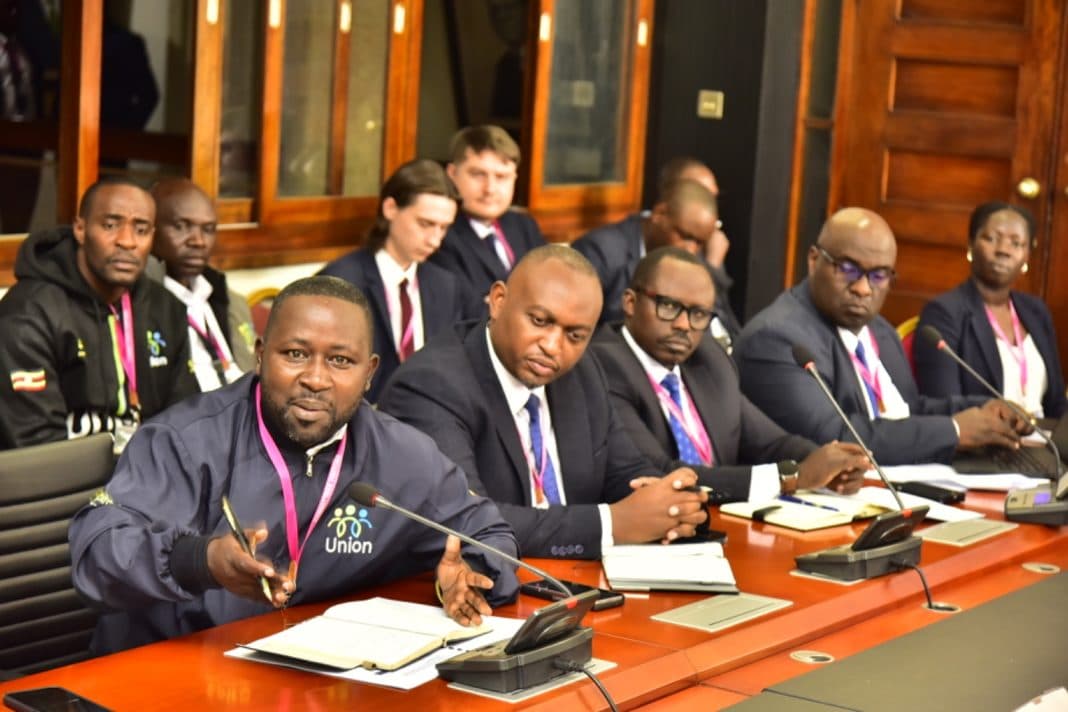
Appearing before the Committee on Physical Infrastructure on Monday, September 28, 2026, UMA leadership, accompanied by logistics agents and transport operators, told lawmakers that the monopoly has disrupted business operations, caused months-long distribution delays, and increased costs for motorists without delivering promised security gains.
Under a 10-year agreement signed with the Government of Uganda in 2021, Joint Stock Company Global Security was awarded exclusive rights to implement the Intelligent Transport Monitoring System (ITMS) and manufacture all digital number plates nationwide.
UMA Board Chairperson Richard Mubiru stated that the technology was introduced primarily to eliminate falsified vehicle registrations and curb motor vehicle crimes, but that the rollout had produced no measurable breakthrough.
Mubiru added that the arrangement effectively locked out two domestic companies that previously produced standard registration plates in the country.
The committee, chaired by Hon. Mwine Mpaka, received testimony from transport operators reporting extensive distribution backlogs and duplicate billing.
Commercial motorcyclist Hassan Ssentongo presented records showing that he applied and paid for a digital transition plate on July 28, 2025 (order number S43461), but never received the plate. When he followed up, he was issued a fresh payment assessment rather than his plates.
National Boda Boda Union Chairperson Frank Mawejje criticized the contractor for shifting blame to geopolitical tensions in the Middle East whenever clients complain about delayed shipments.
Mawejje condemned the steep rise in unit costs from Shs 125,000 to over Shs 700,000, arguing that low-income commercial motorcyclists should not be subjected to the same charges as heavy passenger and cargo vehicles.
He further questioned the practical value of the digital plates, noting that stolen motorcycles continue to be recovered using conventional surveillance cameras rather than the contractor's digital tracking infrastructure.
Kezekia Bwire, Vice Chairperson of the Uganda Clearing Industry and Forwarding Association, questioned the responsiveness and technical reliability of the system, pointing out that several registered vehicles have gone missing without being traced.
Bwire referenced a controlled test where a vehicle was parked inside a garage, yet the company’s police liaison team failed to determine its whereabouts.
Hon. Mpaka stated that the committee is evaluating whether the system's actual security features justify the Shs 714,000 to Shs 715,000 charge levied on motorists.
He announced that the committee will engage the Ministry of Internal Affairs to verify the system's operational viability and assess whether the company has sufficient capacity to satisfy nationwide demand.
Joint Stock Company Global Security’s Project Manager for the ITMS, Damir Makhmutov, acknowledged that the Government had written to the company regarding product shortages and delays.
Makhmutov attributed the delays to disruptions in global logistics caused by international conflicts, but defended the firm's capacity. He noted that the company employs enough personnel to complete 1,500 installations per day, citing 1,307 installations conducted on September 23 alone.
The parliamentary committee is concluding its inquiry and is expected to table a comprehensive report with actionable recommendations before the full House.