

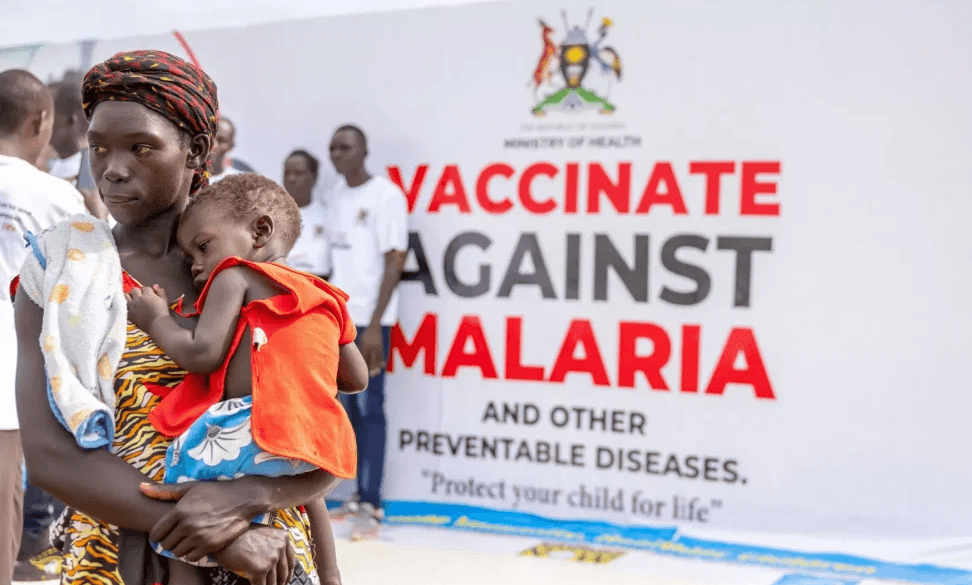
Uganda is intensifying the rollout of the malaria vaccine after new national data revealed a sharp rise in malaria infections among young children, raising fresh concerns among health authorities.
Findings from the Uganda Malaria Indicator Survey (UMIS) 2024–2025 show that about 21 percent of children aged 6 to 59 months tested positive for malaria, more than double the 9 percent recorded in the 2018–2019 survey.
The survey, conducted by the Uganda Bureau of Statistics and the Ministry of Health Uganda between November 2024 and February 2025, offers the latest national assessment of malaria transmission and prevention efforts across the country.
Vaccine added to existing prevention tools
Health officials say the malaria vaccine is now part of a broader national strategy aimed at strengthening protection against the disease.
The approach combines several interventions, including insecticide-treated mosquito nets, indoor residual spraying, testing and treatment, preventive treatment during pregnancy, seasonal malaria chemoprevention and vaccination.
Officials say the vaccine particularly targets children under five years, who face the highest risk of severe illness and death from malaria.
The immunisation programme is being implemented as part of Uganda’s broader malaria elimination plan aimed at reducing infections in high-transmission districts.
Northern and eastern regions most affected
The survey shows malaria remains widespread in several regions despite ongoing prevention programmes.
The Lango sub-region recorded the highest malaria prevalence among children at nearly 60 percent.
The Acholi sub-region followed with about 46 percent, while the Teso sub-region recorded more than 44 percent.
In contrast, urban centres reported significantly lower infection rates.
Kampala registered less than one percent malaria prevalence among children, highlighting a major regional disparity in transmission.
Health experts say such variations explain why the vaccine rollout is being prioritised in districts with the highest malaria burden.
Rural and poorer households face greatest risk
The survey also reveals strong links between malaria infection, poverty and place of residence. Children in rural areas recorded infection rates of about 26 percent, compared to roughly 12 percent in urban areas.
Among the poorest households, 38 percent of children tested positive, compared with only 3 percent among the wealthiest families.
Public health specialists say these disparities reflect differences in housing conditions, access to preventive tools and availability of health services.
The Ministry of Health Uganda says the vaccine rollout forms part of the country’s Malaria Elimination Strategic Plan, which aims to significantly reduce infections and deaths.
The strategy sets long-term goals that include: Reducing malaria incidence across all districts, achieving zero malaria deaths and eliminating malaria in at least 15 districts by 2030.
Officials say findings from the latest survey will help guide where resources and prevention measures should be concentrated.
For decades, malaria has remained one of Uganda’s most persistent public health challenges, particularly among children.
Health authorities say the new data suggests that although prevention efforts have expanded, the disease continues to resurge in some regions.
They believe the malaria vaccine could become a critical additional layer of protection, especially in districts where mosquito control measures alone have not been sufficient.