
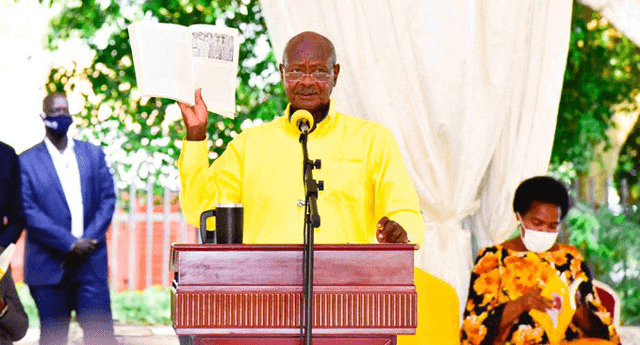
President Yoweri Museveni was last Monday nominated as the National Resistance Movement presidential flag bearer in the forthcoming general elections after which he launched his manifesto under the theme "Securing Your Future".
But what does this actually mean?
The 2021-2026 NRM Manifesto, under the theme "securing your future" focuses on five priority areas which include, creating wealth and jobs, delivering education and health, ensuring justice and equity, protecting life and property, and achieving economic and political integration.
“Over the years, you have renewed this mandate and enabled NRM to make steady progress in taking Uganda to modernity through job creation and inclusive development. We are now ready for take-off,” Museveni says in the foreword of the manifesto.
The NRM candidate says after years of turmoil, the country has been able to enjoy peace for over three decades and that it is these gains that he says his government wishes to consolidate in the next five years.
Industrialization
Over the years, Museveni has emphasized industrialization as one of the key drivers of the country to a middle-income economy through local consumption of goods produced by the industries, as opposed to the importation of the goods consumed locally.
According to Museveni, industrialization is another way of creating employment but also a wealth creation avenue.
“NRM is going to continue with its strategy of building a strong and durable economy. In line with its 10-point program, the NRM government will further develop the economy with the following specific objectives like broadening the economic base by providing and creating economic opportunities in all regions of Uganda and creating an integrated and self-sustaining economy based on import substitution and export-oriented growth,” the manifesto says.
According to the manifesto, whereas nine industrial parks have so far been set up in Namanve, Luzira, Bweyogerere, Jinja, Mbale, Soroti, Karamoja, Kasese, and Mbarara as part of the efforts to secure the future, 21 new industrial parks are proposed to be set up.
Infrastructural development
The new NRM manifesto says that amidst a multitude of problems that Uganda faced, inadequate infrastructure was particularly serious but this has improved over the years.
“By 1986, only 20 (about half) out of 39 district headquarters were connected to the national grid. Today, only four (Kaabong, Karenga, Kotido and Buvuma) out of 135 districts are not yet connected. Work on taking power to Kaabong and Kotido is ongoing and will be completed by December 2020. Government is also going to look for approximately shs45 billion required to supply both Buvuma and Sigulu islands with electricity,” the manifesto says.
The manifesto mentions a number of power stations constructed and others whose construction works as part of the ruling party’s efforts to secure the country’s future in the next five years.
The new NRM manifesto also talks about Uganda’s 159,366km of road network, a total of 5,500km of which are tarmacked.
However, according to Museveni, they wish to extend the network of the tarmacked roads in the next five years as part of the infrastructure development efforts.
The manifesto also talks about improving the traffic congestion in the city which is a menace to city duelers.
“There is need to overhaul most of the roads in the city since they are beyond repair and maintenance. We are going to step up road construction around and across the city, by putting emphasis on the paving of access roads built off the main roads to encourage the development of manufacturing clusters.”
“We shall continue budgeting for public buses in Kampala until when we have enough fleet. We are also going to increase the budget for roads and other infrastructure projects within the GKMA to improve connectivity and overall urban development. We need to accommodate the increasing number of vehicles plying the roads annually, particularly to segregate traffic, enhance safety and reduce journey times.”
Fighting corruption
Corruption has been one of the biggest challenges faced by the NRM government over the years since they assumed into power in 1986.
However, according to the new manifesto, the NRM government hopes to put in place new reforms aimed at dealing with the vice.
“To defeat the corruption of need, NRM will carry out a pay reform and continue with salary enhancements to remove injustices and address the compression ratio in salary scales. This will enable the salary of lower-level cadres to meet their basic needs. We are already progressively dealing with this, starting with teachers, soldiers and medical officers.”
The manifesto emphasizes the crucial role to be played by the State House Anti-Corruption Unit and the Inspectorate of Government in the fight against corruption.
Security
For the past over three decades, security has been the biggest achievement of the ruling NRM government and to this, President Museveni has always boasted of peace in all parts of the country for the first time in over 50 years having defeated Alice Lakwena’s Holy Spirit Movement, Joseph Kony’s Lord’s Resistance Army, Jamil Mukulu’s Allied Democratic Front (ADF) and the Force Obote Back Again.
“The UPDF is built on the correct ideology of being a pro-people army, which professionally responds to challenges and ensures that security prevails. We have instilled the values of discipline, and respect for humanity in the army. Anyone who mishandles wananchi is reprimanded. NRM has continued to build the UPDF through training and equipping it. As a result, the whole of Uganda is secure and peaceful.”
In the new manifesto, the NRM says they will continue strengthening the army and Police to ensure peace but also law and order in all parts of the country.
Highlights of the 2021-2026 NRM manifesto
Health sector
-Renovate or construct theaters and wards in 37 HCIVs without functional theatres.
-Construct at least 500 staff houses for health workers at HCIIIs and HCIVs.
-Construct and equip five regional equipment maintenance workshops.
– Increase access to specialised healthcare services by construction, rehabilitation and equipping of hospitals and super specialised/centres of excellence in line with the National Health Policy.
– Upgrading the physical and technological infrastructure at the Uganda Heart Institute.
-Construction of regional cancer centres in Arua, Gulu, Jinja and Mbarara.
-Construction of the Orthopaedic and Traumatology Institute at Mulago.
-Upgrading of Gulu, Mbale and Mbarara regional referral hospitals to national referral status in a phased manner.
-Equipping of six regional referral hospitals of Gulu, Mbale, Hoima, Bombo, Kawolo and Moroto with CT scans and equipping Mbale, Gulu and Mbarara with MRIs.
Justice and equity
-Exploit processes for remote online adjudication of cases.
– Instill zero tolerance to corruption in the judicial system by introducing systems and periodic performance monitoring of judicial officers.
– Develop sector-wide integration for information sharing starting with critical institutions such as NIRA) and the frontline JLOS service institutions.
– Complete automation of the processes for issuing work permits, visas, special passes and student passes as well as upgrade to a full border management system.
– Roll out the Computerised Prosecution Case Management System (PROCAMIS) to an additional 20 stations
-Implementation of newly enacted commercial laws remains a key priority.
-Criminal cases of a commercial nature should be handled by commercial court as a way of reducing the cost of doing business by fast-tracking commercial legal processes.
-Recruit more judicial officers and other human resources in the judiciary
Education sector
-Provision of instructional materials through increased budget allocation to textbooks and scholastic materials to reach a ratio of 5:1.
-Roll out the Integrated Inspection ICT biometric system in all public schools, which will enable access to real-time data for quick decision-making.
-Continue progressively enhancing salaries and improving other living conditions, particularly staff accommodation for teachers as the economy improves.
-Continue improving the quality of education by strengthening supervision.
-Introduce the school feeding program.
-Construct 258 secondary schools in sub-counties without a public secondary school.
-Provision of instructional materials to improve the teacher/ scholastic material ratio in order to improve the quality of secondary education.
-Progressively rehabilitate the traditionally historical schools.
-Operationalise new government and grant-aided schools by recruiting secondary school teachers and providing science equipment.
– Promote e-learning and computer literacy
-Deal with underutilization of BTVETs through relaxing entry requirements
-Establish Nwoya Agro-processing Technical Institute and upgrade the six BTVET institutions to centres of excellence.
– Complete the construction of facilities in 21 BTVET Institutions