

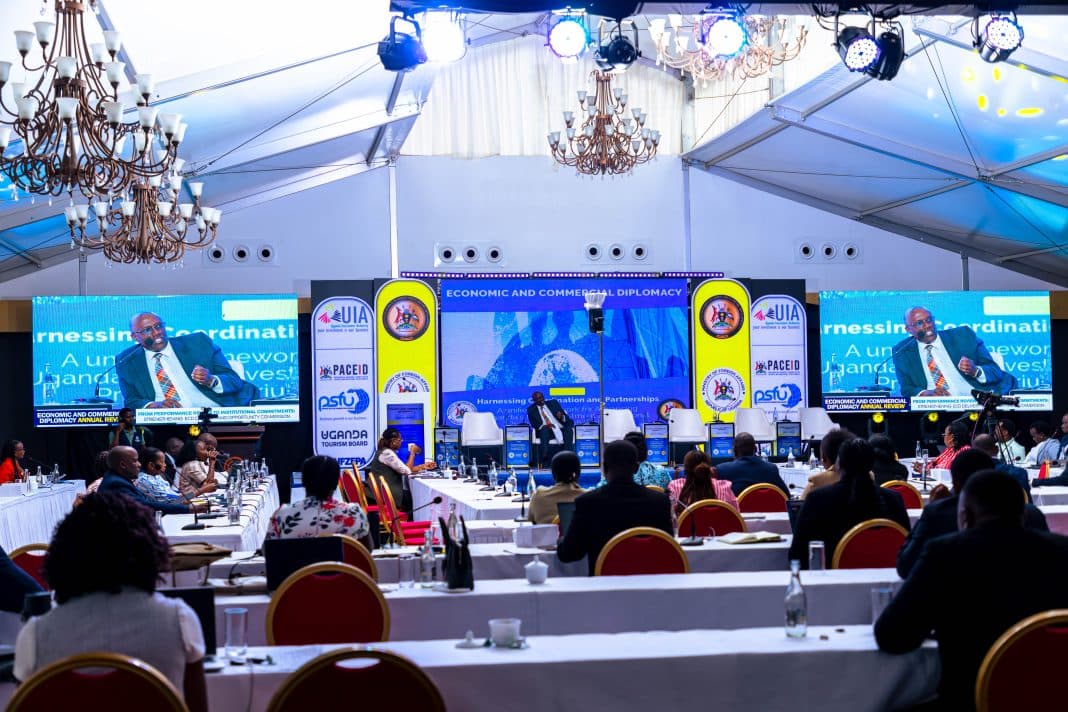
The government has initiated a comprehensive review of its economic diplomacy frameworks to aggressively transform diplomatic ties into actual foreign investments, market access, and export revenues.
The three-day strategy retreat, running from September 16 to 18 at the Lake Victoria Serena Golf Resort & Spa, gathers foreign service envoys, financial planners, trade officials, and private-sector executives.
Delegates are auditing the execution of the 2025/26 Economic and Commercial Diplomacy (ECD) Strategy to eliminate bottlenecks that stall business opportunities abroad.
Opening the session on behalf of the Permanent Secretary Amb. Bagiire Vincent Waiswa, Amb. Richard Kabonero, Head of ECD and Regional Economic Cooperation, declared that the programme has expanded beyond its initial trial phase into full-scale national execution.
Amb. Kabonero revealed that Uganda committed US$35 million to commercial diplomacy in 2026, generating projected financial returns nearly four times higher than the original expenditure.
He stressed that economic diplomacy demands active synergy between diplomatic missions, statutory bodies, and private enterprises.
Finance ministry officials pressed envoys for strict fiscal accountability and tangible economic metrics from their bilateral missions.
Moses Kabanda, Commissioner for Public Administration at the Ministry of Finance, said technical auditors are evaluating specific commercial leads generated by Ugandan embassies.
Kabanda highlighted recurring systemic obstacles, including irregular mission performances, sluggish inquiry responses, deficient market intelligence, and product quality deficits among local exporters.
Ashaba Hannighton, Director of Budget at the Ministry of Finance, stressed that diplomatic activities must yield demonstrable economic results in exports, foreign direct investment, employment generation, and tax revenues.
The policy appraisal follows strong growth across key international indicators.
Uganda’s total export earnings doubled from US$7.8 billion in the 2023/24 financial year to US$15.8 billion in 2025/26.
Foreign direct investment climbed from US$3 billion to US$3.6 billion over the same period.
Inbound international tourist numbers rose from 1.27 million visitors in 2023 to 1.64 million in 2025.
Diaspora remittances expanded from US$1.51 billion to US$2.55 billion within the two-year period.
Delegates are scrutinizing 52 distinct trade, climate-financing, and investment prospects generated by more than 10 overseas missions.
Foreign service directors noted that trade barriers, strict product standards, and slow institutional responses in Kampala continue to hinder Ugandan businesses from finalizing foreign contracts.
The retreat will conclude with the adoption of Uganda’s 2026/27 Economic and Commercial Diplomacy plan, establishing fixed deadlines, institutional owners, and clear performance benchmarks for all foreign missions.