

Uganda Development Bank (UDB) has recorded remarkable financial growth in 2024, with its loan portfolio reaching UGX 1.67 trillion, reinforcing its commitment to Uganda’s socio-economic transformation. The Bank’s total assets also grew by 3%, increasing from UGX 1.67 trillion to UGX 1.71 trillion, driven by increased government funding and support from development partners.
This strong performance highlights UDB’s role in financing projects that drive job creation, industrialisation, and national development.
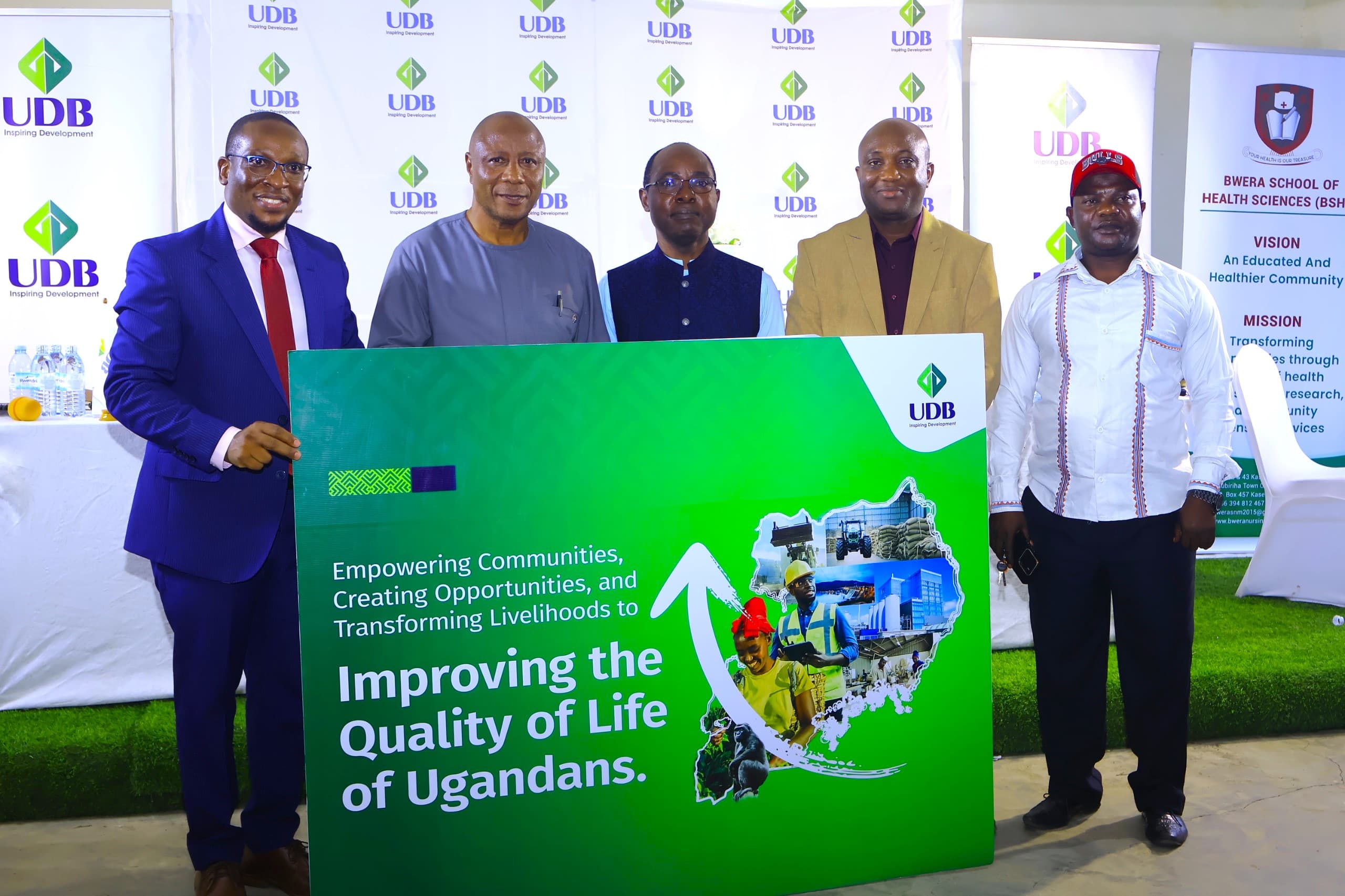
Speaking at a press conference held at Bwera School of Nursing and Midwifery, a UDB-funded institution, the Bank’s Director for Strategy and Corporate Affairs, Joshua Allan Mwesiga, described the financial results as a testament to UDB’s unwavering commitment to fostering Uganda’s prosperity.
He emphasised that UDB is more than just a financial institution, saying, “We are devoted to empowering individuals and businesses across Uganda, stimulating socio-economic growth, and paving the way for a brighter future for our nation.”
In 2024, UDB approved UGX 455 billion for private-sector development across various regions, targeting primary agriculture, manufacturing, tourism, and human capital development. Loan disbursements for the year amounted to UGX 388 billion, with over 770 active projects spread across 105 districts.
The Bank also played a key role in implementing National Development Plan III (NDPIII) programs, with UGX 454 billion allocated to initiatives supporting agro-industrialisation, infrastructure, and education.
The manufacturing sector received UGX 219.67 billion for 32 projects, while agro-industrialisation secured UGX 88.31 billion across 25 projects. Additionally, 52 projects were approved under human capital development, 12 in integrated transport infrastructure, and 32 in tourism development.
UDB intensified efforts to promote innovation, financial inclusion, and sustainable development. The Bank’s investment in green financing saw 34 projects approved, a 13% increase from 2023. It also partnered with the Science, Technology, and Innovation Secretariat to manage a UGX 6.2 billion Innovation Fund, supporting early-stage enterprises in medicine, cassava processing, and silkworm production.
Meanwhile, the Bank’s equity financing pipeline grew by 130%, reflecting a strong commitment to nurturing startups and scaling innovative enterprises.
To enhance financial inclusion, UDB expanded its loan portfolio for SMEs, youth, and women by 39%, increasing from UGX 33.05 billion in December 2023 to UGX 49.50 billion by December 2024. The Bank also provided non-financial support through training, incubation programs, and business advisory services. In partnership with Uganda Management Institute, UDB established an incubation centre to formalise and train businesses, with 71 businesses incubated and 60 graduating with certifications.
UDB’s financial performance for the year ending December 31, 2024, reflected a profit after tax of UGX 55.13 billion. The Bank was named Regional Bank of the Year—East Africa at the 2024 Africa Bankers’ Awards, while its Managing Director received the Sustainability Leader of the Year award for the fourth consecutive year at the Karlsruhe Sustainability Awards in Germany. Fitch Ratings affirmed UDB’s Long-Term Issuer Default Rating (IDR) at ‘B+’ with a Negative Outlook, while the Bank retained its National Long-Term Rating of ‘AAA (uga)’, the highest rating on Uganda’s national scale.
Hon. Godfrey Kabbyanga, State Minister for National Guidance, praised UDB’s resilience, highlighting its ability to provide financial solutions despite economic uncertainties. He encouraged residents of Kasese District and the Rwenzori Region to take advantage of UDB’s affordable loans for growth. Dr. Francis Mulekya Bwambale, Director of Bwera School of Nursing and Midwifery, expressed gratitude to UDB for its support, noting that the Bank’s funding enabled the school to create employment for 33 Ugandans and train over 400 graduates who are now serving in the healthcare sector.
UDB financing also facilitated the construction of a skills simulation lab, an ICT library, a student library accommodating 200 learners, and a multi-purpose hall for 500 students.
Mwesiga reaffirmed UDB’s commitment to driving Uganda’s economic development, stating that the Bank’s continued growth highlights strategic initiatives that enhance financial stability and propel national progress. Dr. Mulekya called for additional government funding to UDB, emphasising that expanding the Bank’s capital base would enable it to create even greater socio-economic impact.
As Uganda’s national Development Finance Institution, UDB remains dedicated to supporting projects that deliver high socio-economic value in job creation, industrial growth, and national revenue generation.