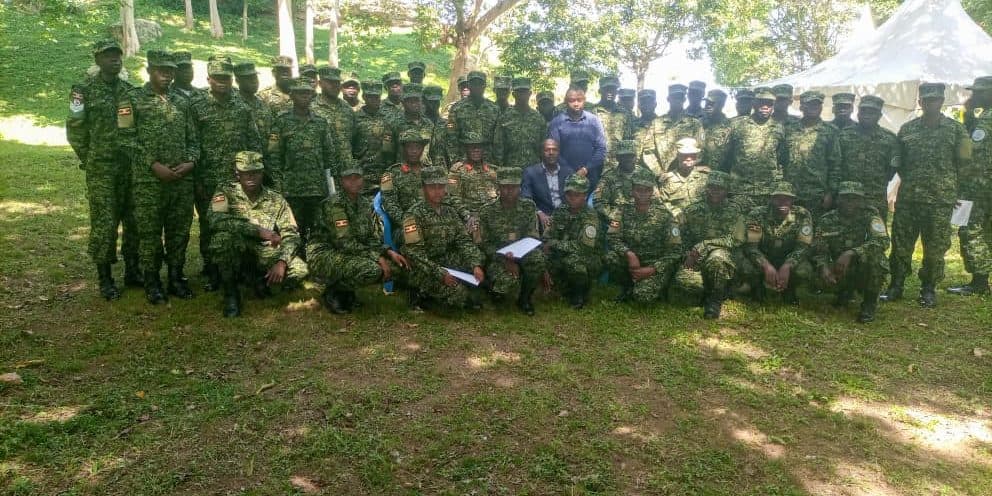
The Uganda Peoples’ Defence Forces (UPDF) and the Ministry of Agriculture, Animal Industry and Fisheries (MAAIF) have passed out 56 personnel to curb illegal fishing and restore depleted aquatic stocks.
The officers completed a intensive three-month orientation course in fisheries enforcement law at the Marine Training School in Kalangalo. The specialized deployment follows a recent institutional reorganization that returned the Fisheries Protection Unit to the UPDF Marine Brigade. The joint initiative aims to secure national water bodies, boost fish production, and generate tax revenue.
The Commander of the Marine Brigade, Brigadier General Michael Nyarwa, urged the graduates to maintain absolute discipline and adhere strictly to standard operating procedures. He used an African proverb to emphasize that inter-agency collaboration is vital to defeating sophisticated cross-border illegal fishing syndicates.
“When spiderwebs unite, they can tie a lion,” Brig Gen Nyarwa said. “The ultimate objective of this mission is to focus on reviving the fishing industry, generating government revenue, and creating employment opportunities that can sustainably support the national economy.”
Brig Gen Nyarwa thanked President Yoweri Kaguta Museveni for providing strategic guidance to safeguard national marine wealth. He praised the Chief of Defence Forces, Gen Muhoozi Kainerugaba, for fostering a highly constructive command climate. The Commander also lauded the Deputy Chief of Defence Forces, Lt Gen Sam Okiding, and the Chief of Defence Intelligence and Security, Maj Gen Richard Otto, for instituting effective fisheries management committees. Furthermore, he recognized the continuous logistical support provided by the Chief of Joint Staff, Lt Gen Jack Bakasumba.
Representing the Commissioner for Fisheries Regulation, Control and Quality Assurance at MAAIF, Alfred Akankwasta, revealed that fish shortages have crippled local manufacturing. He noted that raw material deficits have forced most fish processing factories to close, leaving only four facilities operational. Akankwasta challenged the new officers to apply their legal training to protect breeding grounds and allow the fishing industry to regenerate.
The Commandant of the Marine Training School, Col David Kararira, confirmed that the curriculum adequately equipped the trainees with the necessary tactical skills. He reminded the officers that they bear the heavy responsibility of representing the state during field operations. The Commander of the 155 Battalion, Maj Joseph Sebukera, assured the leadership that the unit is fully oriented and prepared for immediate deployment.
“All efforts must remain focused on achieving the intended operational goals,” Maj Joseph Sebukera stated.